Tuesday, 29 August 2017

Performing Portable Songs


For me, an ideal quality in a song is portability. Can you pick it up in your hand, carry it with you easily and use it in all kinds of circumstances? Can you sing it unaccompanied, can you sing it with just a guitar, just a piano, with a small band, with a big orchestra? I like songs that don’t just look good in a certain light.

I like performing. I like composing songs. As a performer I have only a slight interest in my own songs. Most of them aren’t that good and they make me sound a bit rubbish. Also, and this will sound weird, most of them aren’t really me as a performer. One or two work for me, but most don’t. I guess it could be that they don’t work that well for anyone. So what songs do I have an affinity with?
There are some songwriters whose work just sounds too easy for me, whose work seems to artificially tailored to work with my voice. For me it’s mostly Hoagy Carmichael. Cole Porter usually fits pretty well, but these days sometimes it needs a bit of letting out at the waist. And sometimes there’s more trad stuff that just seems to wail out of something inside you.

I don’t mind some slightly less easily fitting stuff it it’s worth the stretch, but some things are just too specific in their requirements, too un-portable, to be addressed by a solo performer. What’s the point of doing ‘the man who sold the world’ if you don’t have that guitar riff? what’s the point of doing ‘Water Fountain’ without that bass line? Even so, sometimes you find that something that you thought was essential wasn’t really essential at all. Like when KT Tunstall did ‘I want you back’ without a bass. I thought ‘this can’t possibly work’. But it did.

If we’re talking self expression, I think I’d be expressing myself very badly if I concentrated on only performing stuff I wrote myself. It would give a very skewed impression of what I’m all about. There’s lots of stuff, that people don’t know about or under value, that people need to know about, and it’s not me.

Rather fancifully I claim to believe that good portable songs have an ideal socratic form that can’t be tied to any particular specifics of a particular recording or performance. Not even if a recording was made by the composer. An ideal portable song can, in the right hands, have many things changed and still retain its original character. Don’t get me wrong, I’m not saying that the only sort of valid music is portable song. Some good music isn’t at all portable. It has all kinds of requirements to make it work. I don’t want to hear your Mozart quartet arranged for solo banjo, although if the rest of The Punch Brothers turned up, I’d be willing to entertain the idea. However, even with highly constructed work, where the portability isn’t so obvious, a really clever interpreter can mine deeper, study harder and sometimes find an essence that is still totally that work and yet has relatively few of the original’s extraneous features.

To me there are two sorts of authenticity that have to be present in a good performance. The performance has to be the authentic voice of the performer and it must convey the essence of the song. It’s quite possible for a performer to imitate the superficial characteristics of a well known performance and not only totally miss the point of the song but also hide their own voice. Words that give me the fear are ’this is an Ella Fitzgerald song’. To the best of my knowledge, Ella never wrote a song. You’ll hear me saying things like ’This is a song by Bernice Petkere’. And if you don’t know who that is, well you’ve got google haven’t you? Ideally, as a performer, you give yourself to the song. You disappear. For the listener, ideally they only hear you. The composer and the previous performers of the song are forgotten. But the song is remembered.

So when did performing songs that you didn’t write yourself become such despised activity? When did it happen that you couldn’t be a serious artist unless most of the material you performed was your own work? I think it’s to do with the idea that an authentic performance of a song imitates a previous known performance. As I said earlier, I think this does a disservice to both the performer and the song alike. Neither survives the process. No wonder people don’t like it. Partly it’s to do with choice of repertoire, people will choose songs that are popular, but only really work done one way. Find a song with good bones and treat it freely and fairly.

Tuesday, 20 June 2017

The SoundCloud Summer of Love


I don’t think it actually was a summer as such. It was longer and, as it involved people from the northern and southern hemispheres, the idea of linking a season to a time seems meaningless. When exactly was it? 2010 2011 2012? Where did it happen? Nowhere, and all over the world. It happened on a web site called Soundcloud that started off as a very community-oriented music site and ended up as a rather poor sound hosting site.

Whatever it was, it wasn’t a youth phenomenon, at least not from where I was standing. It was mostly people in their 30s 40s 50s and 60s who shared a lot of characteristics. Once upon a time they were nearer to their perfected selves, back in their teens and twenties they’d made a bit of a noise somewhere, some on a very small scale, some right on the agonising edges of the Big Time, mostly somewhere in between. Nearly all felt dispossessed of this perfected self, all felt themselves cut off from the people who were like them, denied an audience, denied a scene.

While there were a few professional musicians (who were very gracious), mostly they were people made a crust, pretended to be normal durning the day at work surrounded by people to whom they couldn’t reveal their true nature. Closet aesthetes pretending to be vulgarians.

Nearly all were adequately tech savvy. Most had been recording stuff one way or another since their glory days and had a frustrated backlog of totally unheard material. It’s as if they were teenagers stuffed with ideas and about to make their big breakthrough album. But of course for them there had been no prospect of an audience, no prospect of a scene and no chance of an album being anything more than a vanity project.

And yes vanity was a big part of it, but it was deeper than that. It was the longing to be listened to, to be considered, to be talked about, to be part of a scene.

How was this scene created? Well we know how it was destroyed, it was destroyed by the introduction of New Soundcloud in 2012. When it came in, people started behaving differently and losing interest, the community was broken. It was like in Awakenings when the L-DOPA stopped working, and one by one people fell back into their previous state or just died. Although people complained about what was wrong with the new version, very few had any insight into what was so clever about the classic version. All they knew was it didn’t feel the same. 

I believe the clever thing about Classic Soundcloud, was that it was a kind of general newsfeed. Whereas all you get alerted to now is postings of people you follow, what you mostly saw in the old Soundcloud was what people were saying about postings. If significant numbers of people that you were following were talking about something which had been posted, even if you didn’t follow the person who posted it, it would appear in your newsfeed. I never did figure out what the algorithm was, whether it was based on numbers of likes or numbers of comments by people that you followed, but at some level of activity a post from an unknown would appear on your newsfeed. It created a perfect online model of ‘buzz’ in the real world. Everyone else was talking about something and you had to know what it was.

Apart from appearing in your newsfeed, comments were much more prominent on the waveform as it was playing, so that you had a clear idea as you listened to it  who was saying what. There were also quite clear conversational threads visible.You got to know who was witty, who was crass, who was nerdy, and most of all who was just flaming weird. And the weird ran deep. Because of the tremendous openness of the site -you could see anyone’s entire activity history- phoneys were obvious. If someone was pasting a trite two word comment on thousands of tracks, it was there for all to see.


So it was all about the comments, all about the interaction and crucially, all about a clever form of almost accidental personal recommendation. 

If an old soundcloud hand visits their account now, they see numbers of plays that are in excess of anything they got in 2011 or 2012. They’ll see the occasional like or follow, but it doesn’t mean anything any more. The drug doesn’t work. If you want to see an incredibly accurate histogram of how many fucks a soundcloud user could give about soundcloud over the years, simply go to their stats page, select the range ‘overall’ and click on ‘Comments’


In a very subtle way, the souncloud classic was a focussed bit of social media. By and large people were the noises they made and the comments they made,. Only rarely did they know each other in a different context. I recall being somewhat freaked out when I found that someone I knew in the real world knew someone that I only knew from soundcloud. People’s visual presence on soundcloud was generally minimal, often totally obscure, occasionally outrageously fraudulent and always entirely in control of the account holder. There was none of this ‘tag bombing’ you get on Facebook where someone finds a picture of you looking particularly stupid or fat.

For myself, the real buzz was international co-operation with talented people I would never have otherwise met. I won’t name any names, because the list would either have to stop somewhere controversial, or be stupidly long.

I’ve always found creating music easiest and most effective when I have a clear idea of the audience I am trying to reach. Having that audience and those collaborators, I was able to produce this:


In basic statistical terms, my 6th most played track but easily the most commented on. It was created by and for the soundcloud community. It enriched my life.

Since the social destruction of Soundcloud, there was a decamping of many connections to Facebook out of sheer curiosity. Facebook is a different kettle of fish and kind of awkward with its mutual friendship rather than follow (I’m sorry you may be interested in me but I was never that into your stuff), with its real world rather than music world concerns. Most people on FB turned out to be delightful, some kinda boring and some real assholes. And there’s an overall sense of having to behave yourself which you never got in the clubbish atmosphere of Soundcloud.


Sunday, 23 November 2014

The Socks Conspiracy

There is a general belief that the problem of unpaired socks is the inevitable consequence of physiology (we have two feet) and the second law of thermodynamics.  This, coupled with some more superstitious beliefs about the gremlins that occupy washing machines.

\delta Q = T\,dS\, .

It is all complete nonsense. The problem of unpaired socks is purely cultural and, might I say comrades, fuelled, if not actually created, by the capitalist conspiracy we find ourselves in.

While the loss,  or terminal degradation of an individual sock is indeed the result of the operation of the second law of thermodynamics,  the idea that can have a bigger impact is a cultural artefact.

It is all to do with the pernicious concept of ‘the pair’.  Yes,  it is true,  the majority of us do have a pair of feet.  They are not just two,  they are a pair, each with their own reflected geometry.  But what of the socks?  Are they a pair?  NO,  they are two socks,  quite identical to each other.


That we are indoctrinated with the idea that a sock can have one,  and only one perfect partner whose loss implies a need for a kind of sock suttee is at the root of the problem.  If all of our socks ( or a significant population of our socks) were identical —I’ve got 10 brown ones,  4 black ones and 6 white ones — all these problems evaporate. The loss of one isn’t a big deal,  if nothing else,  its notional ‘pair’ is at least a spare against the eventuality of the loss of another.

What prevents this ideal world of perfect socks? The Man. Let’s say you have your 10 identical brown socks and a few are eaten by the washing machine/tumble drier/dog,  all you need to do is go to a shop and replace them with some more identical socks.  But you can’t can you?  Because they don’t make them in exactly that style and that colour.  And even if they did,  you’d never find the damn things because of the size of the range of socks.

And that’s only one thing.  Let’s suppose you are resigned to the non-reoccurrence of socks in the shops.  You think,  “I will buy eight ‘pairs’ of identical socks”.  But you can’t.  The socks are not sold as individual pairs but in four-packs.  Well that’s easier isn’t it?  We just buy two packs. NO.  Because the 4 pairs of brown socks in the pack are all contrived so that their colours, indistinguishable in the murk of the sock drawer are glaringly different when worn in a public place.  So you don’t have 16 identical interchangeable socks,  but four lots of four difficult-to-pair socks.  If you lose two of these socks,  the chances are that you will have lost two pairs rather than just one pair. Not that I acknowledge the legitimacy of the concept of a pair of socks.

And now I come to think of it,  why shouldn’t we be able to buy just one sock?  If you lost one,  buy one. It’s time throw off our shackles,  who should we trust? Marks or Marx?


Saturday, 23 August 2014

ICANN Backs Move For Separate Internet For People Who Don’t Get Satire

Anyone who has ever looked at comments on links to The Onion or The Daily Mash or a ‘shreds’ video on youtube knows the problem.  There are just too many people out there who just don’t get it. This can make any reasonable exchange of opinions amongst normal people very difficult.

Extensive experiments were carried out by W3C where ‘special’ users of the internet were provided with irony filter software,  but inevitably some of the satire got through:  maybe a tongue-in-cheek review of a product on Amazon or a sarcastic bit of customer feedback on an eBay user.

For this reason it has been decided to set up a separate internet for people who don’t get satire, who are asatyrical.  After 29th February 2015, when a customer signs a deal with an ISP,  they will be required to answer a short questionnaire which the designers are confident will detect if the customer is asatyrical. If they are asatyrical they will not be connected to the regular internet,  but the new network, Literalnet.  This won’t simply be divided from the regular internet by firewalls,  but will actually use different cables,  satellites,  earth stations and 3/4G networks.

Many sites will have a presence on both networks,  but many sites simply won’t bother with the new network.  Asked if this wasn’t all a lot of hassle,  Scott Leibkind of ICANN (whose former slogan was ‘One World. One Internet’) replied

“On the face of it,  this move is a giant pain in the ass, but when you consider the long term benefits it will bring,  and the appalling consequences of inaction,  I feel we have to act now”

According to Dr Fahrouza Postlethwaite of the Maudsley Hospital London, the problems of asatiricism have only been recognised by science in recent years:  
“until recently we thought these people were just really, really stupid, but now we know that there is a gene that carries the asatiricism trait”. 
She agrees that sufferers need the protection of a separate internet for the sake of themselves and all others.

Although only recently recognised by science,  it’s nothing new.  When Jonathan Swift published ‘A Modest Proposal’ in 1729 it garnered the following actual comments on Facebook:


Thursday, 6 February 2014

I think, therefore I'm not sure

Lazy Philosophizing

The subjective improbability of existence has always puzzled me.  In some ways it seems a blatant and outrageous fact, yet it defies any objective description which can capture the incredulity felt subjectively.

It goes like this. I didn't exist.  I wasn't here in, for example 3rd of March 1950.  I won't exist on the 3rd of March 2090.  There is only a very small and noticeably finite time that I exist.  So how come 'now' is within that tiny time that I exist?  And why am I at all? If any one of a zillion dice rolls had turned out differently I wouldn't ever have been, assuming this corporeal thing is the only thing that ever could be me.  I'm looking at total improbability.  And yet it is the case.

Objectively viewed there's no problem.  Any self aware creature that crawled out of the slime would have this egotistical perception.  They would say that wouldn't they?  But it's baffling when you are that creature. The objective explanation doesn't help my predicament and,  if you share my line of reasoning, it doesn't help with yours either.

If you take the subjective view,  it can lead you to the following theories of existence:

1) I'm here.  It was an amazing occurrence of incalculable improbability.
2) In some way it was inevitable that I was here and that I am always here,  although memory fails me on what exactly I was doing on 3rd March 1950
3) I'm not really here at all

In terms of theories,  2 and 3 pose no statistical challenges.  Both effectively say that nothing improbable is going on (if you buy the theory).  1,  is effectively the null hypothesis,  and given it's self-professed total improbability must be wrong.

So what about the idea that we are continuously existent?  the theory that this point of awareness is just passing through a body,  that it came from another,  that it will pass on to another.  And in between the changes,  drafts from the waters of lethe conveniently take away the memories from one phase to the other. Internally, the maths of this just don't stack up:  there are more people now than there were.  Where did these new ones all come from?  oh yeah,  I know,  they used to be Tigers.  But what about when there wasn't any life on earth?  And in any case in what sense is the existence continued?  The only way I can distinguish myself from others is by my memory,  however recorded,  from the outward appearance of my body to the hidden memories in my head. These are the things that prevent me and others from mistaking me for someone else.Take them away and there's no continuity.

The other theory is to say that the self is an illusion.  This sounds great, but how exactly does that work? I can't decide to suddenly be in a different body with a different set of memories.  I'm stuck with this one. The good old cogito ergo sum is very persuasive.  It keeps telling you that you *do* exist.  I suppose a 'selfless' version would be "something is thinking therefore the thinking thing exists" but no matter how I cut it,  I'm not able to be Descartes.

I'm too lazy to bother reading loads of stuff.  I'm presuming this line of thought has a lot of history and has a name and everything but I'm not aware of what it is.  Anybody got some pointers?


Wednesday, 1 January 2014

Of Tires, Tyres and Implied Anachronism

Of Tyres and Implied Anachronism

The new logo on Hovis bread depicts a baker's errand boy pushing a safety bike bearing a large basket with the legend 'Since 1886'.  Now obviously that's referring to the antinquity of Hovis flour,  but you can't help reading it as meaning that lads have been struggling with heavy loads on bikes since 1886. And I'm pretty sure that's not true.

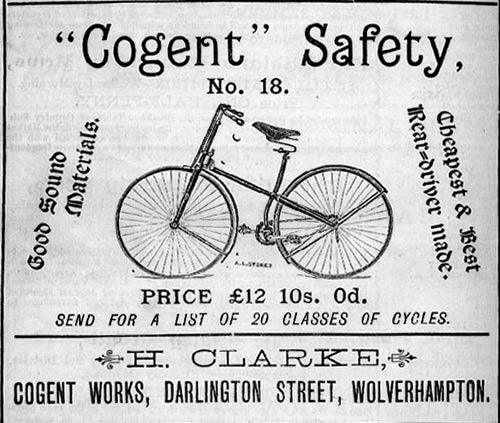
Granted, the safety bicycle (that is to say NOT a penny farthing) had already been popularised by John Starleys 'Rover' safety cycle in 1885;  the small wheels and chain drive meaning that you were no longer in danger of performing a spectacular faceplant when you braked, but it was still an extremely boneshaking device having no pneumatic tires.  If you attached a basket to it,  and rode it down a cobbled street,  I'm pretty sure all the loaves would be out of there before you'd got anywhere near Mrs Blenkinsop at no. 85.  And this is all assuming that an errand boy would have a bike in the first place.  Bear in mind we're talking 'urchin' here.  In the Sherlock Holmes stories of the 1890's when a boy was thrown sixpence to do some running,  are we ever told that he jumped onto his 'Cogent Safety Cycle' and pedalled off furiously?  No,  because in 1887,  that bike cost exactly 500 sixpences (£12 10s 0d).

It's true that,  in Belfast in 1887,  John Dunlop's son had a bike,  but his dad was a vetinary surgeon,  and given that Dunlop went on to (re-)invent the pneumatic tire,  it's fairly safe to assume he would now be recognised as a geeky early-adopter. He created the pneumatic tire specifically because the vibrations gave Dunlop junior a headache. Incidentally John Dunlop wasn't the first to invent the pneumatic tyre,  a patent had already been filed by a fellow Scot Robert Thompson.  I suspect the dispute was settled on quality of beard, with Dunlop just edging it:


The pneumatic tire not only relieved stress on the rider,  but also the bike itself,  meaning that the bikes didn't have to be as strongly or heavily built and actually became cheaper as well as easier to ride. John Dunlop started The Dunlop Pneumatic Tyre Company in 1889 and it must have been from this point on that cargo bikes really became practical. Theoretically.

Searching Google Books for the phrase 'postman's bicycle' returns only one hit in publications before 1900,  and that was in 'The Postal Record' in 1896,  a good 10 years after the hypothetical Hovis bike and 7 years after Dunlop started up.


I kind of wonder what the boy would have used instead,  my guess is a barrow or some kind of sack trolley,  although I suppose a milkmaid-style yoke with baskets wouldn't have been out of the question.  But with bread, it's not so much weight as volume that's the problem,  so I'm voting for the barrow.

You'll notice an irregularity in my spelling of 'tire'.  With no reference cited,  the Wikipedia page on tires alleges that until 1840 there is no record of anyone spelling it 'tyre' and that the first appearance was in the application of soft iron tyres to the cast iron wheels of railway rolling stock. Maybe it was the novelty of having a tire that was softer than the wheel (unlike the iron hoop on a wooden cartwheel) that made them reach for a new spelling?  Tires and Tyres,  Bites and Bytes?

Why did they need these tyres anyway?  It was because the railways were developed before Bessemer had (re-)invented the continuous process for the  mass-production of steel, so the railways started with cast iron rails and cast iron wheels.  These were so heavy and brittle, it was only one step better than making them out of stone.  Only by having a soft iron tyre between the wheels and the rails did they avoid the whole system just shattering.  In places where tensile or torsional strength was required in locomotives or rolling stock, it was necessary to either use wrought Iron or very expensively produced steel that was made in batch processes. The investment in railways was so grea that this didn't hold up their development,  it just meant that when steel was more readlily available it all became a lot easier.

While you could produce a railway without cheap steel you couldn't really make a bike,  and as you weren't going to get the kind of invesment that went into the railways, it wasn't really worth even thinking about chain drives until 1855,  even then it took about 30 years to get it right.

Saturday, 11 September 2010

And now I say, what's the point of putting up music with a purely spurious video content. I'm not a video artist. And I've discovered the joys of putting stuff on this, which is really easy.