The new logo on Hovis bread depicts a baker's errand boy pushing a safety bike bearing a large basket with the legend 'Since 1886'. Now obviously that's referring to the antinquity of Hovis flour, but you can't help reading it as meaning that lads have been struggling with heavy loads on bikes since 1886. And I'm pretty sure that's not true.

Granted, the safety bicycle (that is to say NOT a penny farthing) had already been popularised by John Starleys 'Rover' safety cycle in 1885; the small wheels and chain drive meaning that you were no longer in danger of performing a spectacular faceplant when you braked, but it was still an extremely boneshaking device having no pneumatic tires. If you attached a basket to it, and rode it down a cobbled street, I'm pretty sure all the loaves would be out of there before you'd got anywhere near Mrs Blenkinsop at no. 85. And this is all assuming that an errand boy would have a bike in the first place. Bear in mind we're talking 'urchin' here. In the Sherlock Holmes stories of the 1890's when a boy was thrown sixpence to do some running, are we ever told that he jumped onto his 'Cogent Safety Cycle' and pedalled off furiously? No, because in 1887, that bike cost exactly 500 sixpences (£12 10s 0d).
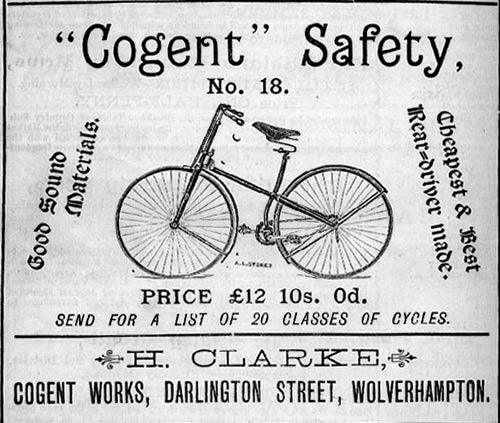
It's true that, in Belfast in 1887, John Dunlop's son had a bike, but his dad was a vetinary surgeon, and given that Dunlop went on to (re-)invent the pneumatic tire, it's fairly safe to assume he would now be recognised as a geeky early-adopter. He created the pneumatic tire specifically because the vibrations gave Dunlop junior a headache. Incidentally John Dunlop wasn't the first to invent the pneumatic tyre, a patent had already been filed by a fellow Scot Robert Thompson. I suspect the dispute was settled on quality of beard, with Dunlop just edging it:


The pneumatic tire not only relieved stress on the rider, but also the bike itself, meaning that the bikes didn't have to be as strongly or heavily built and actually became cheaper as well as easier to ride. John Dunlop started The Dunlop Pneumatic Tyre Company in 1889 and it must have been from this point on that cargo bikes really became practical. Theoretically.
Searching Google Books for the phrase 'postman's bicycle' returns only one hit in publications before 1900, and that was in 'The Postal Record' in 1896, a good 10 years after the hypothetical Hovis bike and 7 years after Dunlop started up.

I kind of wonder what the boy would have used instead, my guess is a barrow or some kind of sack trolley, although I suppose a milkmaid-style yoke with baskets wouldn't have been out of the question. But with bread, it's not so much weight as volume that's the problem, so I'm voting for the barrow.
You'll notice an irregularity in my spelling of 'tire'. With no reference cited, the Wikipedia page on tires alleges that until 1840 there is no record of anyone spelling it 'tyre' and that the first appearance was in the application of soft iron tyres to the cast iron wheels of railway rolling stock. Maybe it was the novelty of having a tire that was softer than the wheel (unlike the iron hoop on a wooden cartwheel) that made them reach for a new spelling? Tires and Tyres, Bites and Bytes?
Why did they need these tyres anyway? It was because the railways were developed before Bessemer had (re-)invented the continuous process for the mass-production of steel, so the railways started with cast iron rails and cast iron wheels. These were so heavy and brittle, it was only one step better than making them out of stone. Only by having a soft iron tyre between the wheels and the rails did they avoid the whole system just shattering. In places where tensile or torsional strength was required in locomotives or rolling stock, it was necessary to either use wrought Iron or very expensively produced steel that was made in batch processes. The investment in railways was so grea that this didn't hold up their development, it just meant that when steel was more readlily available it all became a lot easier.
While you could produce a railway without cheap steel you couldn't really make a bike, and as you weren't going to get the kind of invesment that went into the railways, it wasn't really worth even thinking about chain drives until 1855, even then it took about 30 years to get it right.


No comments:
Post a Comment